Showing posts with label high medieval age. Show all posts

Friday, July 24, 2009

Anna "Banana" of Byzantium. A Historical Novel Review.


Anna of Byzantium
by Tracy Barrett

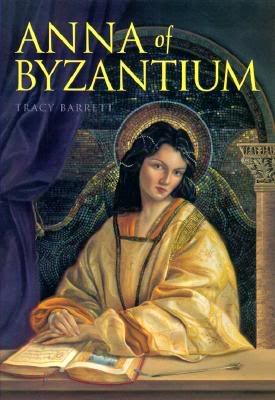
Cover:
I really like this cover. It's like she's coming out of a mosaic into life; bringing the past into the present. Very illustrative of the time period and attractive.

Summary: From her seat in a lonely convent on the frontier of the Byzantine Empire, Anna Comnena looks back on her short life, and how she fell from empress to exile.

My Review: I love a good medieval story, so I was excited when I found this one on Amazon. A Young Adult novel that takes place in the Byzantine Empire? I'm there! I haven't read much about the Byzantines, and only know what I do from two medieval history classes in college. However, I've been a Young Adult reader my whole life, so I feel confident considering myself something of a connoisseur in that regard.

The book started out promisingly enough in the 12th century, describing daily life in a convent. On a personal note, here, I am always amazed at how people have slept through the night throughout history. Anna describes to us how the nuns wake up at various early hours to pray and complete daily chores, many of them before the sun has risen. How did everyone always wake up so early? How did they get enough rest on their meager bedding? Nowadays, it's hard for us to imagine sleeping in anything less than a completely silent, pitch-black room on a comfy pillow-top mattress... it never ceases to amaze me!

Moving on: Anna is sulking a little bit to be cooling her heels in the convent, so she asks permission to help in manuscript illumination. In doing so, she will have access to all the writing materials necessary to complete her own history of her royal family in a book that would come to be known as The Alexiad, detailing the chivalrous life of her father, Alexius Comnenus.

Anna is remarkably literate, not merely for a woman, but for any person in the high middle ages. She knows passages from Homer and Virgil by heart, and is heavily influenced by the heroic age in her own writing. She believes she is born to rule and to set the empire to rights, after the machinations of her grandmother have upset the court. At the tender age of 13, Anna is capable of manipulating court politics to her advantage, knowing that any wrong move could end not only in losing her power, but result in a death sentence.

She is torn between the love she holds for her mother, who herself is a descendant of the royal Ducas family that was conquered by Alexius, and the power she knows her grandmother holds over her father and her weak brother, John. Here, too, Anna must choose whose influence she will want in her own court, and whose influence she will use to get there.

I liked that Anna holds unpopular opinions. She makes no apology for believing that she is destined by God to rule over others, and she goes so far as to plot the death of her brother by poison, believing she may be saving the empire in doing so. While our modern sensibilities balk at these extremes, a true medieval mind would have believed these ideas without doubt. I think it's important that Young Adult authors stick to this development, no matter the harsh realities, because finding the truth in history is what's ultimately important.

Nevertheless, I couldn't help the feeling that the story was ultimately "dumbed down," and incredibly truncated, to make it "easier to read" for intermediate readers, and I never really approve of that. For instance, Anna wishes that her maid address her as "Your Majesty," a title that was not in popular use until Henry VIII's time, when absolute rule came into being. I don't know what the proper title for a future empress would be (I know "Porphyrogenita" would be somewhere in there, in reference to the Byzantine royal color purple), but I know "Your Majesty" isn't it. That could have been an interesting detail in which to educate the readers, and instead Barrett glossed over it with an anachronism. Furthermore, there is very little description of architecture, background, and the physical aspects of what it would be like to live during the era. I don't think the reader gets enough historical information out of this historical novel: it's more like a character sketch.

In regards to the character: I feel like there wasn't enough of an arc in Anna to make the end satisfying. She goes from a confident ruler to a vengeful reject to a bored exile, and that's it. She doesn't come to personal terms with her mistakes, which results in the second half of the book dragging to a conclusion. It's as if, as soon as she loses the throne and her betrothed, there wasn't anything else to write about her, which would actually contrast with the author's vision.

Overall, this was a great historical figure to choose, and I applaud the author for choosing to write it as a Young Adult fiction, but it's more of a sketch than a novel.

Visit the author's website

Buy this book on Amazon

Tuesday, June 30, 2009

We all love Richard, but sometimes we can love too much. A Historical Novel Review.


The Murders of Richard III
by Elizabeth Peters

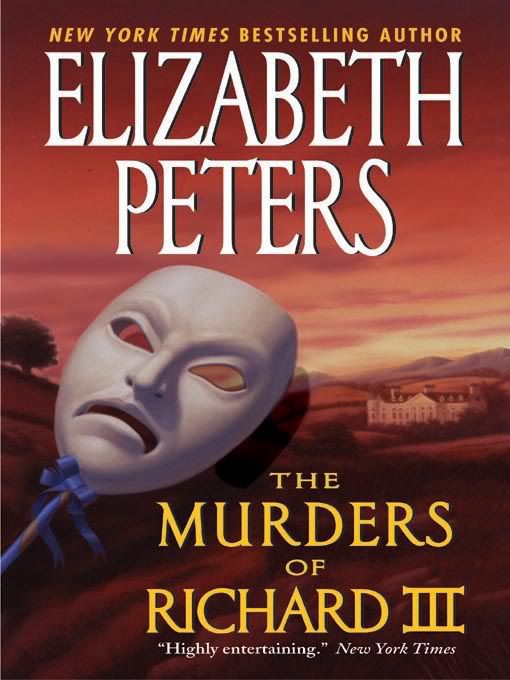
Cover: Blah, what is that?!? That has absolutely nothing to do with anything in the story! A drama mask?!? So generic and ridiculous; I’m cutting myself off from complaining any further. Except I will add that when I was reading this on the bus across campus the other day, I’m sure I looked like quite the murder mystery fan.

Summary: Jacqueline, an American librarian with a dry sense of humor and a mysteriously large purse, entrances her British colleague enough for him to invite her for a special getaway while she is working in England. Thomas is a member of a pro-Richard III society that is having a gathering at an old manor house, and he wants Jacqueline to accompany him, although with an ulterior motive: he thinks her dabbling in old manuscripts might help them authenticate a Plantagenet age letter. The letter may or may not be the legendary missive from Elizabeth of York to her uncle Richard, believed lost to time, that might help prove Richard’s innocence in the deaths of the York princes. It supposedly details Elizabeth’s desire to marry Richard, which would be incongruous if he had already murdered her brothers and was trying to force himself upon her.

So the two arrive at the society meeting, which Jacqueline finds begins to resemble an English manor house party more than any sort of professional outing as the hours pass. The host believes he is an illegitimate descendant of Richard, is named Richard, and collects all sorts of Ricardian paraphernalia. In addition to dressing up as Richard. In fact, all the guests are dressed in medieval costume and have taken up the roles of the principal characters of the Wars of the Roses, no matter if they resemble the famous figures at all.

The party becomes even stranger as Jacqueline realizes that all the society members discuss and rehash the Wars of the Roses as though they had happened weeks ago, rather than centuries. They all seem entirely too invested in proclaiming Richard’s innocence. And on the first night, one guest has already taken the debate too far, and endangered a life. Jacqueline is almost pleased to find herself in the middle of a real, old fashioned English house party, and jumps right into solving the mystery, even if it means death could be on the line.

My Review: I will never not love an Elizabeth Peters novel (she writes the Amelia Peabody Egyptology mystery series, and if you haven’t read those yet, DO. IT.) so I may be am most definitely biased. But, it bears stating: I loved this book and devoured it in two sittings.

Despite my own summary right up there, the book is actually told (sort of) from Thomas’s point of view. Jacqueline, however, provides most of the outsider (or “our” viewpoint) commentary on all the events, so that is why she would probably be the main character. Of course, she is also the one to solve the mystery in the end, in a grandiose, old style, Sherlock Holmes type of explanatory monologue. The difference between this kind of ending and the mustache-twirling, villainous-explanation that I don’t really like lies in the author’s style; Peters is just ridiculously charming and witty. She is one of the few writers with whom I laugh out loud while reading.

I came to the wrong conclusions, of course, before the mystery was finally revealed, so I can also chalk that up to a decent read, and the “murderer” was fairly believable. I kind of wished that the mystery had had more to do with solving a Ricardian mystery, as well, but Peters deals with that in a tongue-in-cheek manner in the final pages, so I came away happy with the ending.

There is plenty of Ricardian historical chatter throughout the book, anyway, and it easily added a bit on to what I read in The Daughter of Time. This book has a great commentary on the nature of possession, and how the subject of our passions kind of possesses us, no matter if it’s a passion based 500 years in the past. Even sarcastic, smooth-talking American Jacqueline can’t avoid getting caught up in Ricardian drama. Even though this is an easy-to-read and entertaining mystery novel, there was plenty of character development and lingering moments to get caught up in.

Some notes I took while reading:

  • In the first pages, Jacqueline off-handedly judges all the royal figures in the National Portrait Gallery on a scale of sexiness. This is awesome.
  • Thomas discovers Jacqueline has actually heard the theory about Richard’s innocence before… when she read The Daughter of Time. Later on, Thomas brushes up on his pro-Richard debate skills be rereading Paul Kendall’s Richard the Third, which is the history book I picked up the other day. Well, I’m glad I’m in good company!
  • It is 1970s England, so there are a few elements that today could not figure in to this mystery. No one has cell phones, which would have solved the missing persons problem, carbon-dating techniques are briefly mentioned but today would be much more sophisticated, not knowing what someone looks like and yet not being able to look him up on Facebook, and the women’s pantsuits sound really weird. But it allows Thomas to keep holding old Social Class Issues, which are very funny.
  • Jacqueline is more amused than horrified by the dress-up activities of the society. I imagine I would react the same way, so this had me grinning throughout, as well.
  • There is a “boy” named Percy, who speaks to all the adults as though he is on the same level as them within the society, and takes on the role of one of the York princes, but I could never figure out how old he is. Especially since he is supposed to be enormous and fat. Whatever.
  • On P. 125 of my paperback: “Thomas found himself trying to decide which nation could claim the least-attractive tourists.” Ha! Love it.
  • When something goes wrong, all the members of the society automatically jump to the conclusion that an anti-Ricardian has penetrated their midst. Not, you know, that maybe someone is just trying to break into their house and steal things. This seems sooo fitting for so many “societies” today that I was highly amused.
Also, I finally figured out how to adjust the size of the pictures I post, so... yeah... I don't know why I didn't do it before.
Buy this book on Amazon

Monday, June 29, 2009

Before the Da Vinci Code, there was The Daughter of Time. A Historical Novel Review.


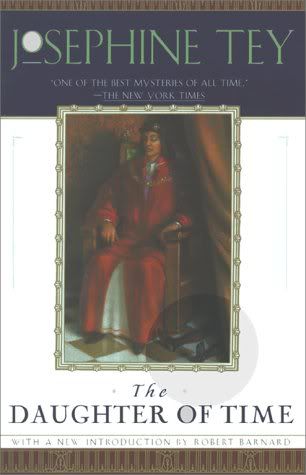
The Daughter of Time

by Josephine Tey


Cover: I don’t know if you can tell from the picture here, but in the painting there is a pair of feet coming out from underneath a tapestry. This is irrelevant to anything that happens in the book, but quaintly intriguing, in that old “whodunit” sort of way.


Summary: Did Richard III really murder “the princes in the Tower”?


Inspector Grant of Scotland Yard is laid up in hospital for months with a leg horribly broken in the line of duty. He is dismayed to be without any sort of stimulating activity, grumbling to nurses and visitors alike, until one of his old friends presents him with a series of historical portraits. Knowing that he has a knack for discovering characters by examining faces, she implores him to study the portraits and see if he can resolve famous crimes of history. He lights upon one portrait of a man he claims could not be guilty of a crime, and is surprised to learn that it is Richard III, famous for brutally slaying his nephews and hiding their bodies toward the end of the Wars of the Roses. Everyone he consults seems to see something different in the face, but none conclusively see it as that of a murderer, much less a cold-blooded one. With the help of his friends, Grant sets himself to the task of vindicating the story of Richard.


My Review: This is a short book (about 200 pages), but I didn’t want to put it down for a moment… and the whole thing technically takes place in Grant’s hospital bed. It is a brilliant “literary thriller,” and for all I know it was one of the first of the genre, having been written in the 1940s. While the main character himself is never in any danger, I kept turning each page as fast as possible to find out what else the characters were going to find out… would they ultimately be disappointed? How could these two discover something that vigilant historians and royal scholars had not discovered over the last several centuries? I was hooked.


The novel acts as a great “gateway drug” (hehe!) to becoming addicted to Ricardian lore. I currently understand very little about the Wars of the Roses (being more of a Tudor reader, myself) and now I want to see if I can uncover for myself whether or not Richard could be guilty of the murder of the princes.


The main evidence—and I don’t think I’m spoiling anything here if it’s 500 year old information, but just in case… SPOILER—rests on the fact that there is no contemporary record of an accusation against Richard during his lifetime. Inspector Grant points out that the murder of the princes should have acted as a rallying cry for Henry VII’s troops as he headed into the final battle at Bosworth. Furthermore, there were other heirs besides the two boys… in fact, there were nine others. Richard would have had a lot more killing to do.


And so on. I don’t know if I believe yet that Henry Tudor killed them, as Grant concludes, but he puts up a great case that makes it practically impossible to believe that Richard could have done the deed.


If you have ever done research, I think you’ll sympathize with the characters’ struggle for the perfect evidence for their theory, and if you enjoy British humor, I think you’ll like it even more.


Some notes I took while reading:


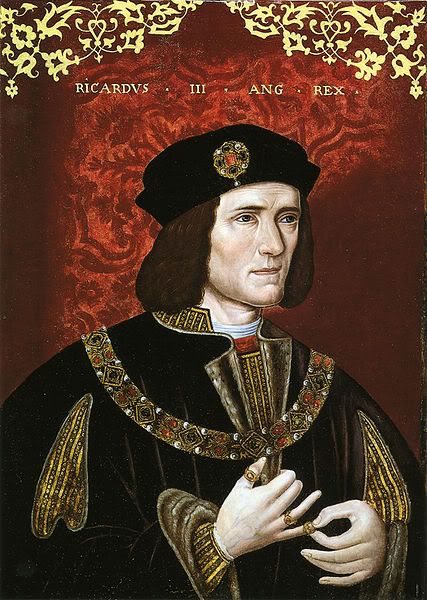
  • This is the portrait referred to in the novel, which is now part of the Royal Collection. According to this terrifically helpful article from the Richard III Society, it was definitely painted about 100 years or so after Richard's lifetime, but was likely a copy from a portrait painted from life. There is apparently evidence that the painting was later revised, probably to make Richard slightly uglier and more in fitting with the Tudor "mythology." The shoulder that we see on the left was repainted to look higher than the one on our right, and the eye that we see on the left was made to look narrower. The lips may have been thinned as well. All in all, this is what created the hunchbacked, monstrous character we all know and love.
  • While waiting for more primary document research to be conducted by his friend, Inspector Grant consults a novel on Cicely Nevill. On P. 59 of my paperback copy: "It was, moreover, the almost-respectable form of historical fiction which is merely history-with-conversation, so to speak." Heeeeey... I see what you did there, Josephine.
  • I love the ending, when Grant's research assistant comes to the devastating realization that he was not the first to absolve Richard of the murders. It's such a great moment that everyone has every once in a while, where you realize it's really hard to be original. But you have to keep going and keep searching and keep working at what you love, and Grant's assistant knows he must carry on in his mission.


I highly recommend this book. I read it for the first time years ago when a teacher recommended it to my history class, and reading it for the second time now, knowing a bit more and having done research for school, I got even more out of it. I want to go and read more about the Wars of the Roses and Richard, so I picked up a history book and an Elizabeth Peters mystery, The Murders of Richard III, at my last bookstore/library visit. Look for those reviews here in future.


Buy this book on Amazon

Thursday, June 25, 2009

Law & Order: 12th Century... A Historical Novel Review


The Serpent's Tale
By Ariana Franklin

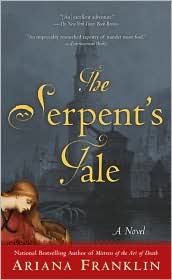
Cover:
This particular cover is pretty photoshoppy. A painting laid over a painting with an embossed title on top of that. Also, the coloring is dark and pretty unattractive. But then, covers are never the most important aspect of a book, anyway.

Summary: Adelia Aguilar, an Italian in xenophobic 12th century England, is King Henry II’s “Mistress of the Art of Death.” In other words, she is an early forensics investigator. Using methods gleaned from studying under a medieval physician and her own experiences, Adelia can figure out when and how the king’s subjects meet their untimely deaths.

In this latest mystery, Adelia is commanded to uncover the true story behind the attempted murder of the king’s mistress, Rosamund, in her tower at Wormhold. Accompanied by a eunuch assistant, Mansur, her dog Ward, her maid Welsh maid Gyltha, and her young child Allie, she sets off for Woodstock.

They are led by Bishop Rowley, who before he became a man of the cloth fathered Allie, and who believes they will arrive only to find Rosamund dead. He’s right. Surrounded by a nearly-impenetrable labyrinth (the “serpent” of the title) and frozen in a high tower, the king’s mistress is dead, but she still holds a secret. Rumors of war, carried over from the civil war between Stephen and Maud, have begun to surface again, this time between King Henry and his queen, Eleanor of Aquitaine. Eleanor is interested in Rosamund’s possessions, and may have had an interest in Rosamund’s death. Adelia can ascertain that Rosamund was poisoned, but as to whom is the culprit, there is an entire village nearby full of suspects.

In fact, some of the villagers themselves are falling prey to a killer who may or may not be related to Rosamund’s murder. Amidst royal intrigue, scientific inquiry, and state politics, Adelia must further fear for her own safety, and for that of her child. Someone seems to be aware that Adelia is on the case, and that she may know more about murderers than the average 12th century Englishwoman…

My Review:
I absolutely adored the beginning of this novel and could not put it down for the first 150 or so pages. Franklin is entirely convincing in describing the mythical tower of Wormhold and suggests a dark, Gothic twist on the relationship between Rosamund and Henry. I read Alison Weir’s Eleanor of Aquitaine not that long ago, however, so I am entirely disillusioned when it comes to the romance of Rosamund.

Weir disputes pretty thoroughly the existence of any sort of castle near Oxford where Henry could have kept his mistress. In fact, consulting the book now, she says “Rosamund’s death would in time give rise to many legends, none of which have any truth in them” (1). By her account, even by the 14th century there were tales of Eleanor poisoning Rosamund, burning her alive, and other dastardly sordid acts. Eleanor was, of course, already imprisoned at this time and so could not have poisoned Rosamund herself, not to mention that there is no evidence of any labyrinth that could have stood for the infamous one that protected Rosamund.

So, what can I say; I’m a bit jaded toward the subject matter already. But who doesn’t love a little alternate history? I still plowed through the first half of the book fairly quickly, and it was only when I got to Rowley’s disappearance from the novel and a sudden downturn in the action that I could put the book down.

Franklin does a fair job of rendering interesting dialogue that matches the social status of the individual characters. There is a fine line between conveying a low class accent and writing a parodied, incomprehensible dialogue, and Franklin toes it with ease.

Franklin also approaches these historical figures out of legend from multiple angles, which should appeal to a wide audience. Sometimes Henry is immature and almost comical in his ego trips, and sometimes Eleanor seems shrewish and petty (read her scene in Wormhold to see this unpredictable turn of character), but ultimately I think fans will be satisfied with the turn that Franklin gives them. However, you definitely have to read to the very last page to get that satisfaction…

Adelia, our heroine, provides an almost-21st century perspective, probably so that the audience can more easily connect with the medieval mindset. She is comfortable and confident being an outsider in a hostile land, being an unwed mother in a strictly religious society, and various other anachronisms. I understand that Franklin wants to reach a wider audience than only the history snob geek squad, but I think I found it harder vacillating between Adelia’s more “welcome” perspective and the antiquated medieval mindset. It’s hard to sympathize with the medieval characters when you keep getting thrust back into a modern mindset because that happens to be your “eyes and ears.”

Of course, another viewpoint is that the Middle Ages were, in fact, early modernism, and so it might not be entirely impossible that a woman like Adelia could have the opinions and drive that she does. No two people are exactly alike, and anyway I’ve mentioned before how even the most famous historical figures never followed all the rules of their society. So, I hope to hear from more people what they thought about the more “anachronistic” aspects of this novel!

Franklin’s plotting is well-paced, except for that mid-novel break that made it too easy for me to put down, and her resolution is satisfying and believable. There is no deus ex machina here, which was refreshing, and the characterization and ending left me wanting to read the next book in the series.

The side characters are funny and interesting and show immense care on the author’s part to develop a world and mythology for her heroine to live in for a longer series. In fact, Henry and Eleanor are almost “side” characters in this series, although you’re still interested to read more about their exploits. Overall, I was entertained and intrigued by The Serpent’s Tale, and I look forward to reading the next book in the series, Grave Goods, particularly since it involves Arthurian legend.

Some notes I took while reading:

  • While Adelia’s “unmarried mother” status is questionable, the men’s reaction to it as she moves from location to location is hilarious.
  • On p. 34 of my paperback: “Rosamund Clifford?” “That Rosamund.” As if they could be unsure which Rosamund de Clifford the king’s priest had been talking about.
  • Be aware: there is some serious, rampant feminism afoot in this book. Although, the way they’re treated throughout, it’s impossible not to sympathize.
  • Also, there are quite a few graphic descriptions of corpses, murders, fetid medieval folk, and other dastardly sordid acts. It’s not for the weak of stomach, but it's probably pretty educational.
  • There is a villainous confession toward the end where I half-expected the culprit to twirl a mustache or add "And I would have gotten away with it, too, if it wasn't for those meddling kids and their dog." I mean, there are other ways to end a mystery novel. I'll have to read some more of this author's books to see if there is a pattern.

Visit the author's website

Buy this book on Amazon

1. Weir, Alison. Eleanor of Aquitaine: A Life. New York: Random House. 1999.