
The Murders of Richard III
by Elizabeth Peters
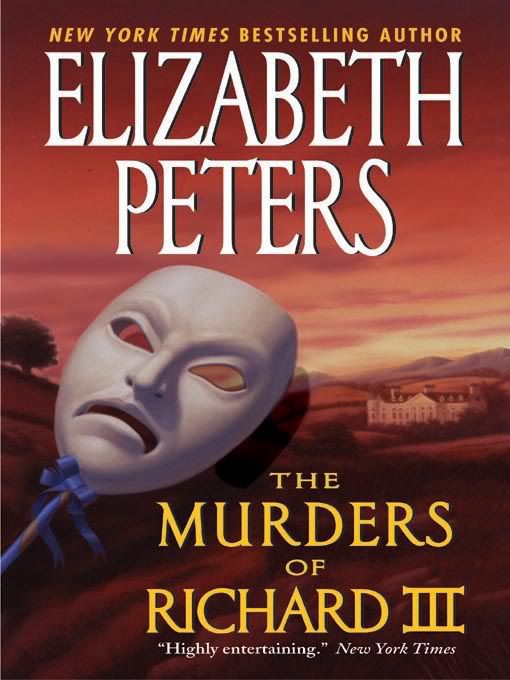
Cover: Blah, what is that?!? That has absolutely nothing to do with anything in the story! A drama mask?!? So generic and ridiculous; I’m cutting myself off from complaining any further. Except I will add that when I was reading this on the bus across campus the other day, I’m sure I looked like quite the murder mystery fan.
Summary: Jacqueline, an American librarian with a dry sense of humor and a mysteriously large purse, entrances her British colleague enough for him to invite her for a special getaway while she is working in England. Thomas is a member of a pro-Richard III society that is having a gathering at an old manor house, and he wants Jacqueline to accompany him, although with an ulterior motive: he thinks her dabbling in old manuscripts might help them authenticate a Plantagenet age letter. The letter may or may not be the legendary missive from Elizabeth of York to her uncle Richard, believed lost to time, that might help prove Richard’s innocence in the deaths of the York princes. It supposedly details Elizabeth’s desire to marry Richard, which would be incongruous if he had already murdered her brothers and was trying to force himself upon her.
So the two arrive at the society meeting, which Jacqueline finds begins to resemble an English manor house party more than any sort of professional outing as the hours pass. The host believes he is an illegitimate descendant of Richard, is
named Richard, and collects all sorts of Ricardian paraphernalia. In addition to dressing up as Richard. In fact, all the guests are dressed in medieval costume and have taken up the roles of the principal characters of the Wars of the Roses, no matter if they resemble the famous figures at all.
The party becomes even stranger as Jacqueline realizes that all the society members discuss and rehash the Wars of the Roses as though they had happened weeks ago, rather than centuries. They all seem entirely too invested in proclaiming Richard’s innocence. And on the first night, one guest has already taken the debate too far, and endangered a life. Jacqueline is almost pleased to find herself in the middle of a
real, old fashioned English house party, and jumps right into solving the mystery, even if it means death could be on the line.
My Review: I will never not love an Elizabeth Peters novel (she writes the Amelia Peabody Egyptology mystery series, and if you haven’t read those yet, DO. IT.) so I
may be am most definitely biased. But, it bears stating: I loved this book and devoured it in two sittings.
Despite my own summary right up there, the book is actually told (sort of) from Thomas’s point of view. Jacqueline, however, provides most of the outsider (or “our” viewpoint) commentary on all the events, so that is why she would probably be the main character. Of course, she is also the one to solve the mystery in the end, in a grandiose, old style, Sherlock Holmes type of explanatory monologue. The difference between this kind of ending and the mustache-twirling, villainous-explanation that I don’t really like lies in the author’s style; Peters is just ridiculously charming and witty. She is one of the few writers with whom I laugh out loud while reading.
I came to the wrong conclusions, of course, before the mystery was finally revealed, so I can also chalk that up to a decent read, and the “murderer” was fairly believable. I kind of wished that the mystery had had more to do with solving a Ricardian mystery, as well, but Peters deals with that in a tongue-in-cheek manner in the final pages, so I came away happy with the ending.
There is plenty of Ricardian historical chatter throughout the book, anyway, and it easily added a bit on to what I read in
The Daughter of Time. This book has a great commentary on the nature of possession, and how the subject of our passions kind of possesses us, no matter if it’s a passion based 500 years in the past. Even sarcastic, smooth-talking American Jacqueline can’t avoid getting caught up in Ricardian drama. Even though this is an easy-to-read and entertaining mystery novel, there was plenty of character development and lingering moments to get caught up in.
Some notes I took while reading:
- In the first pages, Jacqueline off-handedly judges all the royal figures in the National Portrait Gallery on a scale of sexiness. This is awesome.
- Thomas discovers Jacqueline has actually heard the theory about Richard’s innocence before… when she read The Daughter of Time. Later on, Thomas brushes up on his pro-Richard debate skills be rereading Paul Kendall’s Richard the Third, which is the history book I picked up the other day. Well, I’m glad I’m in good company!
- It is 1970s England, so there are a few elements that today could not figure in to this mystery. No one has cell phones, which would have solved the missing persons problem, carbon-dating techniques are briefly mentioned but today would be much more sophisticated, not knowing what someone looks like and yet not being able to look him up on Facebook, and the women’s pantsuits sound really weird. But it allows Thomas to keep holding old Social Class Issues, which are very funny.
- Jacqueline is more amused than horrified by the dress-up activities of the society. I imagine I would react the same way, so this had me grinning throughout, as well.
- There is a “boy” named Percy, who speaks to all the adults as though he is on the same level as them within the society, and takes on the role of one of the York princes, but I could never figure out how old he is. Especially since he is supposed to be enormous and fat. Whatever.
- On P. 125 of my paperback: “Thomas found himself trying to decide which nation could claim the least-attractive tourists.” Ha! Love it.
- When something goes wrong, all the members of the society automatically jump to the conclusion that an anti-Ricardian has penetrated their midst. Not, you know, that maybe someone is just trying to break into their house and steal things. This seems sooo fitting for so many “societies” today that I was highly amused.
Also, I finally figured out how to adjust the size of the pictures I post, so... yeah... I don't know why I didn't do it before.
Buy this book on Amazon




 Posts
Posts


